Hello

MAXI Column Protection

PROTECT – IT MAXI COLUMN GUARDS FREQUENTLY ASKED QUESIONS

Why choose Protect-it MAXI column guards?

Protect-it MAXI column guards are a simple, effective and an economical way to minimize damage to structural columns, walls and assets in building, carparks and warehouses. Here are some key reasons to choose MAXI:

  • Interlocking, modular construction that adapts to suit your site.
  • Easy ‘wrap around’ installation with no drilling, velcro or fasteners (except for wall installations.
  • Low purchase cost, efficient freight and simple installation. Individual replacement of damaged modules.
  • Suitable for use in cold stores down to -40°C.
  • Chosen by industry leaders worldwide for over 15 years.

How do Protect-it MAXI column guards works?

Protect-it MAXI column guards combine clever design, Computer Aided Engineering (CAE) and advanced thermoplastic materials to deliver a product that can absorb large impacts.

Each MAXI has an outer wall that is integrally moulded to a series of curved ‘spring like’ energy absorbers at the front and sides to provide two levels of protection for columns and walls. Under light to moderate impacts MAXI deforms to resist the impact before returning to its original shape. Under higher impacts MAXI deflects even more, contacting the energy absorbers and delivering increased impact absorption.

This staged response makes MAXI flexible enough to accommodate everyday knocks and bumps yet robust enough to withstand substantial forklift impacts.

No alt text provided for this image

What performance testing has been done?

Protect-it MAXI column guards are designed with the same proven impact absorption technology as Protect-it rack guards. MAXI has undergone extensive Finite Element Analysis (FEA) simulation during the product development process. The FEA simulations found that:

  • With Protect-it MAXI column guards installed on a 100UC_15* (4”) column, no column damage was evident after a 2.7 ton forklift impact at 2km/hour.
  • With Protect-it MAXI column guards installed on a 200UC_59* (8”) column, no column damage was evident after a 2.7 ton forklift impact at 6km/hour.

Are Protect-it MAXI column guards cost effective?

A high quality column protection solution will quickly pay for itself by minimizing forklift damage and costly repairs to columns and walls. Protect-it MAXI column guards provide exceptional value for money with an affordable purchase price, rapid installation and very low maintenance costs.

Are Protect-it MAXI column guards easy to install?

The interlocking, modular assembly of Protect-it MAXI column guards creates an easy ‘wrap around’ installation which can be adapted to suit your site. It’s a simple as arranging the MAXI guards around a column and then inserting the pin connectors.

Enhancing Pallet Tracking with Wrap-Around Labels

In many distribution centers, full pallet loads are shrink-wrapped to secure individual cases to the pallet. These pallets are then stored in designated rack bay locations, each identified with a barcode label, until they’re ready for shipping.

One efficient solution for tracking these pallet loads is the use of “wrap-around” LPN labels. These dual barcode labels wrap around the corner of a pallet, providing several key benefits for warehouse operations.

Why Choose Wrap-Around Labels?

  1. High Visibility Wrap-around labels are easily visible from two angles, allowing workers to quickly and easily locate them. With two labels per pallet, each side has a scannable label, enhancing operational efficiency.
  2. Accurate Scanning – These labels are large and easy to spot, facilitating quick and accurate scans. They also feature large human-readable numbers or letters, improving verification and accuracy.
  3. Enhanced Inventory Management – Wrap-around barcode labels support the needs of modern smart warehouses, driving efficiency, speed, automation, and accuracy in inventory tracking and management.

Additionally, another reason LPN labels are applied to palletised loads is due to the varying designs and configurations of pallets used by customers. Typical pallet markers cannot easily be fitted to the corners of pallets unless there is some form of standardization, such as using Euro or ISO pallets (GKN-Chep), where there is consistency in the pallet blocks.

Integrating wrap-around labels into your warehouse operations can significantly streamline your inventory processes and improve overall operational efficiency. Upgrade your pallet tracking system today with wrap-around labels for a smarter, more efficient warehouse.

Project Case Study

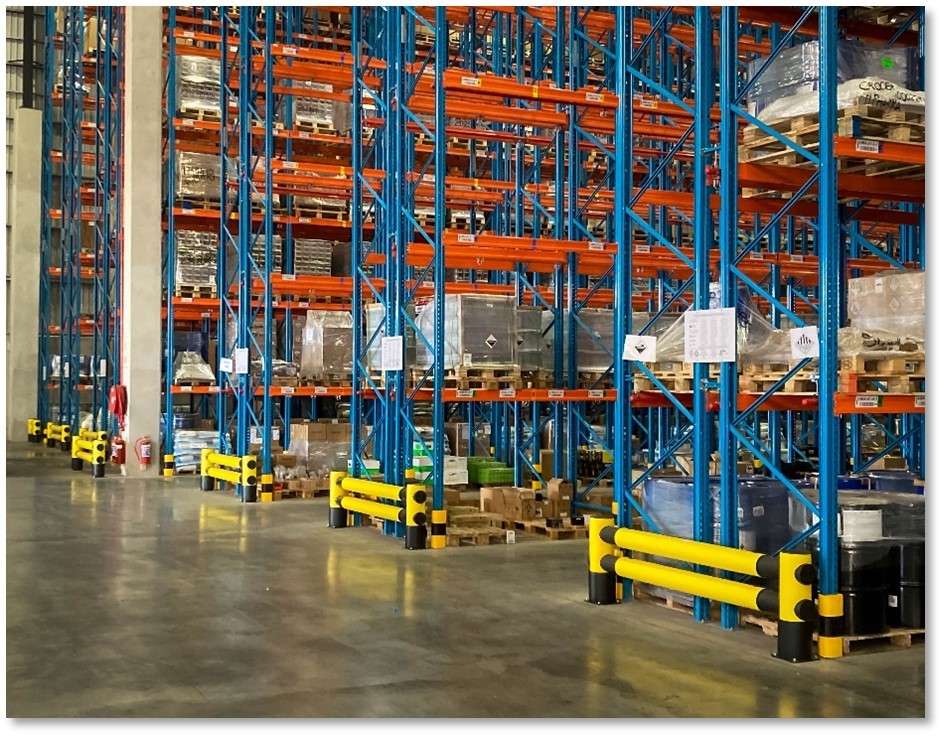
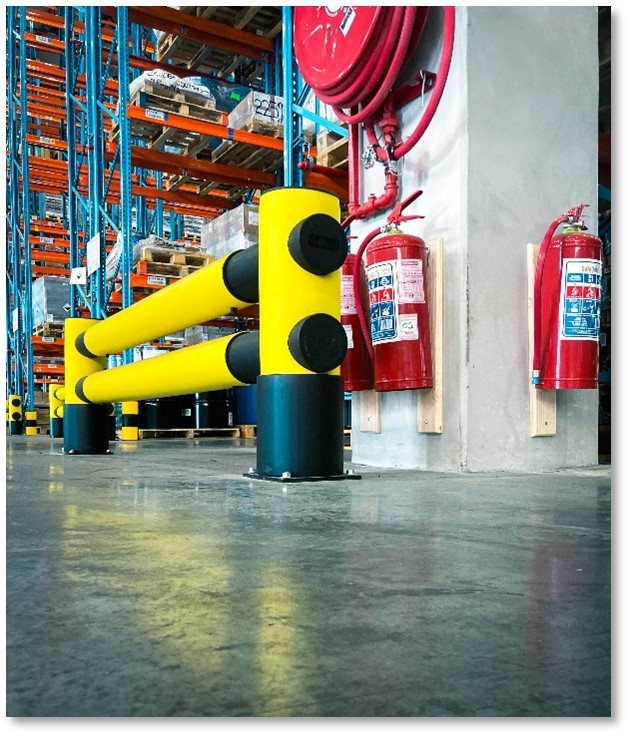
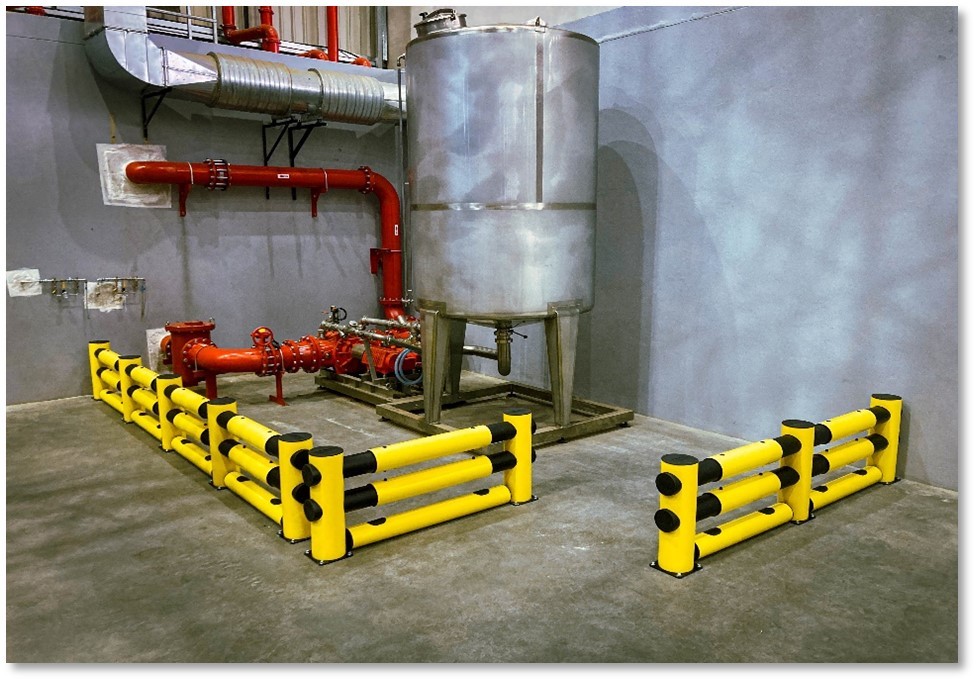
PROMHS was recently requested to design and offer a barrier solution for a client’s flammable warehouse in Jet Park, South Africa. Preference was given to Polymetric Barriers which has a lesser ignition potential in relation to the typical industry steel barriers. PROMHS approached their distributor d-flexx whom offer one of the best engineered safety barriers that are designed not to increase the risk of fire or fire spreading at the place of use.

UNDERSTANDING MATERIAL PROPERTIES:

When it comes to assessing fire hazards in polymer barriers, the choice of materials is critical. Some manufacturers opt for cheaper and potentially more dangerous materials, which can significantly increase the risk during a fire. The table below compares key properties of d-flexx PE, PVC, and PP materials to highlight why careful selection is essential.

PE: HIGHLY CHEMICAL AND CORROSION RESISTANT, IMPACT RESISTANT AND LOW WATER ABSORPTION

IGINITION TEMPERATURE:

The ignition temperature of a material indicates the amount of thermal energy needed to start a fire. d-flexx PE barriers have an ignition temperature of 350°C, higher than flexible PVC and wooden pallets. This means that in the event of a fire, d-flexx barriers will likely be among the last to ignite, reducing their role as fire accelerants.

THERMAL DECOMPOSITION TEMPERATURE:

Thermal decomposition temperature is the point at which a material begins to chemically break down and lose its shape. PE polymer remains stable up to 340°C, whereas PVC starts decomposing at 249-273°C. In practical terms, materials with lower decomposition temperatures, like PVC, will fail sooner in a fire compared to more fire-resistant materials like PE.

SMOKE AND TOXIC FUMES:

Smoke development in a fire poses a significant danger to humans and animals, often more so than the flames. Many polymer barriers emit toxic smoke; PVC, for example, releases harmful hydrogen chloride. In contrast, PE materials, such as those used in d-flexx barriers, do not emit environmentally hazardous gases during combustion, making them a safer choice.

HORIZONTAL FLAME RETARDATION

According to the UL94 fire classification, a material with a thickness of 3mm to 13mm should decompose by fire at a rate no greater than 40mm per minute. The PE polymer used in d-flexx barriers meets this standard, classified as UL94HB, confirming its effective flame retardation capabilities.

BENEFITS of d-flexx

–      One for all temperature ranges -40 to 50°C

–      Saver choice during combustion (no hazardous gases)

–      Decomposition temperature 340 – 350°C

–      Flash point (ignition) 350-360° C

#PROMHS #SafetyBarriers #WarehouseSafety #FacilitySafety #FacilityMaintenance #WarehouseMaintenance #SafetyProducts #IndustrialSafety #WorkplaceSafety #SafetySolutions #PolymericBarriers #SafetyEquipment #SafetyInnovation #CaseStudies #WorkplaceProtection #PolymericGuardrails #PolymericSafetyBarriers #dflexx