
8 questions every warehouse manager should ask before the year-end rush.
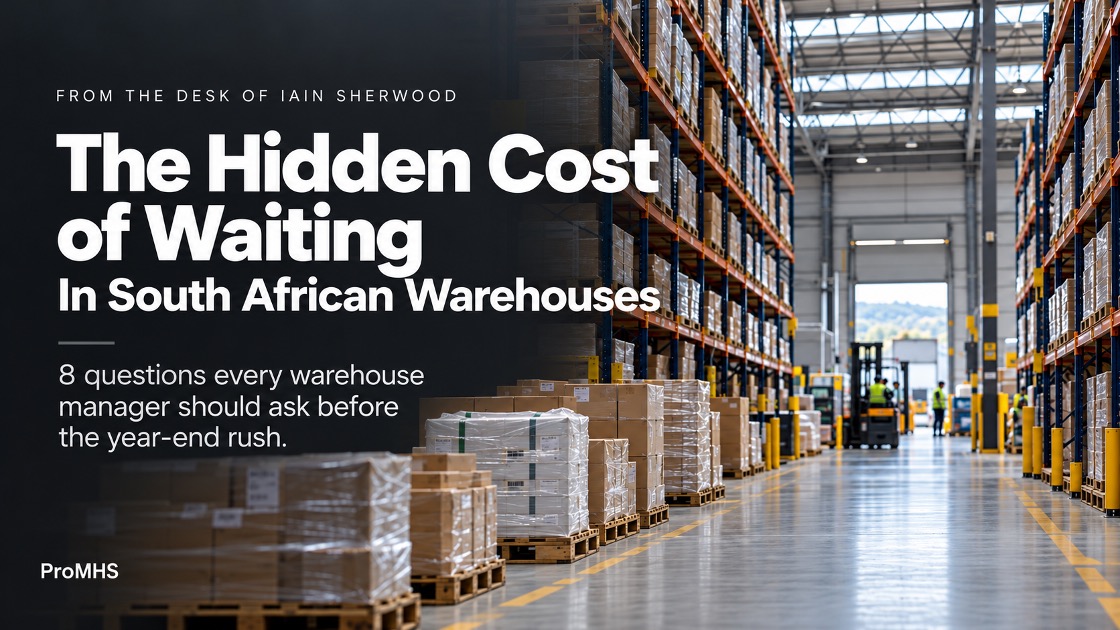
From the desk of Iain Sherwood | ProMHS | October 2026
A busy warehouse can be reassuring. Forklifts are moving, people are picking and trucks are coming through the gate. But activity tells us very little about how long an order spends waiting between those movements.
As South African businesses prepare for year-end trading, I believe that waiting time deserves more attention. Before asking a team to work faster, we should ask what prevents its work from moving forward.
The commercial backdrop makes this timely. World Wide Worx forecasts South African online retail spending of about R159 billion in 2026, representing estimated growth of 22.5%. That is growth in sales value, not a direct measure of warehouse workload, but it strengthens the case for reviewing fulfilment capacity before the seasonal rush.
Meanwhile, local warehousing coverage highlights limited suitable modern space in key logistics nodes and older facilities that struggle to meet changing operational needs. For managers working within an existing footprint, the question is how much more useful capacity their current operation could provide.
My starting point would be the time lost between tasks. Stock waits to be checked. A picker waits for replenishment. A completed order waits for paperwork. Each department may be busy, yet the customer’s order barely moves.
Here are eight questions I would put on the management agenda this October.
1 Where does an order spend the most time waiting
Follow a few actual orders from arrival to dispatch. Record the gaps between tasks as carefully as the tasks themselves. The longest delay may occur between two departments that each believe they are meeting their targets. That handover is where I would start.
2 Are we solving the bottleneck or feeding it
If dispatch cannot clear completed orders, pushing more work through picking may simply fill the staging area. Match the release of work to what the next step can handle. Review whether an improvement at one workstation actually helps an order leave the building sooner.
3 What happens when the delivery plan changes
For warehouses receiving imported stock, test what happens when planned deliveries arrive together after a delay. Agree who can revise receiving priorities and how transporters will be informed. A revised arrival time needs an operational response, including space and people ready to receive the goods.
4 Which decisions depend on one person
Ask what stops when your most experienced supervisor is unavailable. If only one person knows where overflow stock goes or how an exception is resolved, write down the decision rules and train a backup. Knowledge should help the whole operation function, including during leave periods.
5 Is our spare space actually usable
A vacant patch of floor is not automatically useful capacity. Can stock reach it safely? Can it be identified and retrieved without moving other goods? Review access, handling and replenishment before counting an area as available. Otherwise, today’s overflow can become tomorrow’s obstruction.
6 Are we measuring success through the customer’s order
Picks per hour can improve while dispatch deadlines are still missed. Review whether orders leave complete, correct and on time, then investigate the delays behind exceptions. Departmental productivity matters, but it needs to contribute to the result the customer is paying for.
7 What are our people working around every day
Ask the team which problem they have learnt to live with. Repeated double handling, unclear instructions or a system that does not reflect the physical location can become normal through familiarity. A workaround is useful evidence of a process that needs attention. Make it easy to report one.
8 What can we improve before we spend
Choose one recurring delay, establish its current impact and test a manageable change. Compare the result before extending it. This creates a stronger basis for investment decisions: you can see which constraint remains and what additional capacity or capability the business actually needs.
Make October a month for removing delays
My advice is to spend time at the handovers. Ask why goods are waiting, who owns the next step and what would allow the work to continue. Those answers can help you direct effort and investment to where they will make the greatest difference before year-end.
If your team would benefit from an independent view of where work stalls, speak to ProMHS at www.promhs.co.za.
Sources
[1] World Wide Worx, SA online retail to reach R159 billion in 2026, 2 September 2026. https://www.worldwideworx.com/onlineretailsa2026/
[2] Freight News, Warehousing plays key role, 9 March 2026. https://www.freightnews.co.za/article/warehousing-plays-key-role