
For many businesses, sustainability has become a corporate objective driven by customer expectations, ESG commitments and evolving environmental regulations. But for warehouse operators, sustainability isn’t simply about ticking compliance boxes—it’s about making smarter operational decisions that reduce waste, improve efficiency and create long-term value.
The reality is that sustainability begins long before products leave the warehouse.
It starts with how materials are stored, how waste is managed, how infrastructure is protected and how businesses maximise the resources they already have.
The most sustainable warehouse isn’t necessarily the one spending the most money—it’s the one wasting the least.
Rethinking Waste
Walk through any busy warehouse and you’ll find cardboard, plastic wrap, strapping, shrink film and packaging waste being generated every hour of every day.
While these materials are often recyclable, the way they are managed can significantly impact productivity, housekeeping and safety.
Overflowing bins, cluttered aisles and unnecessary manual handling don’t just create environmental challenges—they slow operations, increase risks and consume valuable floor space.
Managing waste at the point where it is generated helps create cleaner workflows while improving recycling efforts and reducing unnecessary handling.
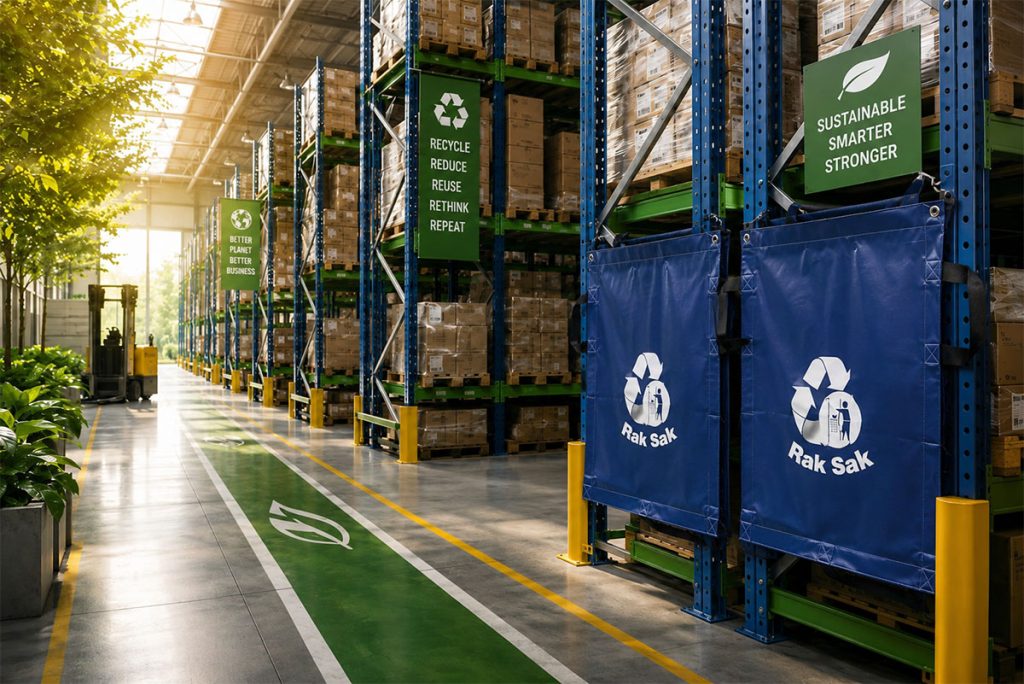
At ProMHS, we’ve seen firsthand how simple housekeeping improvements can transform warehouse operations. Solutions like RakSak provide dedicated collection points for cardboard, plastic wrap and packaging waste directly from existing pallet racking, encouraging recycling at the source while keeping aisles clear and workstations organised. It’s a practical example of how small changes can support both sustainability goals and day-to-day operational efficiency.
Small Changes, Significant Impact
Sustainability doesn’t always require major infrastructure upgrades.
Often, the biggest improvements come from simple operational changes such as:
- Reducing unnecessary packaging waste
- Improving waste segregation
- Eliminating disposable bin liners where practical
- Introducing reusable storage and collection systems such as RakSak
- Protecting warehouse infrastructure with d-flexx impact protection for logistics facilities, STOMMPY polymer barrier systems for food and pharmaceutical environments, and Protect-it rack protection
- Improving warehouse identification through professional warehouse labelling
- Creating safer pedestrian and vehicle routes with floor markings and visual safety solutions
- Optimising existing storage capacity before expanding facilities
These everyday improvements reduce waste while creating safer, more efficient warehouse operations.
Designing Warehouses That Last Longer
One of the most overlooked aspects of sustainability is longevity.
Every damaged rack upright, cracked concrete column or bent safety barrier represents more than just a maintenance cost. It means additional raw materials, manufacturing, transport and installation—all of which increase the environmental footprint of a warehouse.
Protecting existing infrastructure is often far more sustainable than replacing it.
This is where preventative protection plays an important role.
For logistics, warehousing and distribution centres, flexible impact protection systems such as d-flexx, together with Protect-it rack protection solutions, help safeguard racking, building columns, machinery and pedestrian areas from forklift impacts. By preventing avoidable damage, businesses reduce maintenance costs, minimise material waste and extend the lifespan of critical warehouse infrastructure.
For food manufacturing, pharmaceutical and hygiene-sensitive facilities, STOMMPY polymer protection systems offer a long-term sustainable solution. Manufactured from advanced engineering polymers that resist chemicals, moisture and corrosion, STOMMPY barriers are designed to perform for many years in demanding environments. Their exceptional durability means they rarely require replacement, reducing material consumption, maintenance interruptions and the environmental impact associated with manufacturing and installing new protection systems.
Whether protecting a busy logistics warehouse with d-flexx or safeguarding food and pharmaceutical facilities with STOMMPY, investing in long-lasting infrastructure protection helps businesses reduce waste while creating safer, more efficient warehouse operations.
Smarter Waste Management
Every warehouse generates waste. Cardboard cartons. Plastic wrap. Strapping. Stretch film. Damaged packaging. The challenge isn’t eliminating these materials—it’s managing them efficiently.
Too often, waste ends up in temporary bins scattered throughout the warehouse, overflowing onto floors or creating unnecessary obstacles for forklift operators and warehouse staff.
This is where smarter housekeeping solutions make a real difference.
Purpose-designed storage solutions like RakSak help businesses collect cardboard, plastic, packaging and recyclable materials directly from existing pallet racking, keeping waste off the warehouse floor and making recycling easier.
Unlike traditional floor bins that occupy valuable warehouse space and often become obstacles themselves, RakSak utilises unused vertical space on pallet racking to create convenient collection points exactly where waste is generated. Employees can immediately dispose of cardboard, shrink wrap, plastic strapping and packaging without interrupting workflow or creating unnecessary clutter.
Available in a range of sizes and configurations, RakSak integrates seamlessly into existing warehouse layouts and can be positioned throughout facilities to encourage better housekeeping habits and improve recycling rates.
The result is a cleaner, safer warehouse that makes waste management part of everyday operations rather than an afterthought.
Another opportunity to reduce waste lies in the way goods are secured during internal warehouse transport. Instead of using metres of disposable stretch film every day, Sanstrap® reusable stretchbands provide a simple, reusable alternative for stabilising cartons, trays and palletised goods during internal movements. This not only reduces plastic consumption and packaging waste but also improves efficiency by making loads quicker to secure. For businesses looking to further strengthen their sustainability initiatives, Sanstrap Re is manufactured using 30% post-consumer recycled plastic (PCR) and is 100% recyclable, supporting circular economy goals while maintaining the same reliable performance.
Sustainability and Productivity Go Hand in Hand
- There is a common misconception that sustainability costs money.
- In reality, many sustainable warehouse practices also improve productivity.
- Cleaner workspaces reduce unnecessary movement.
- Better organisation improves picking efficiency.
- Long-lasting infrastructure reduces replacement costs.
- Reusable systems minimise ongoing waste.
The same principle applies across the wider ProMHS product range. Accurate warehouse labelling reduces picking errors and unnecessary stock movement. Clearly defined pedestrian walkways and floor markings improve traffic flow and reduce accident risks. d-flexx protects high-traffic logistics environments from costly forklift damage, while STOMMPY provides long-term infrastructure protection for food and pharmaceutical facilities where hygiene and durability are essential. RakSak improves recycling at the source, while Sanstrap helps reduce reliance on single use stretch film during internal transport. Sustainability isn’t achieved through one product—it’s the result of many smarter operational decisions working together.
More Than an Environmental Goal
Sustainability isn’t just about reducing environmental impact.
It’s about building warehouses that are safer, smarter and better equipped for the future.
Every decision—from protecting racking and improving housekeeping to reducing disposable waste and introducing reusable solutions—contributes to a workplace that performs more efficiently while using resources more responsibly.
As Iain Sherwood, Managing Director of ProMHS, explains:
“The most sustainable warehouse isn’t necessarily the one with the biggest environmental programme—it’s the one that wastes the least. Every time we protect a rack from damage, extend the life of a building asset, improve recycling or help a client make better use of their existing space, we’re reducing waste while improving operational performance. That’s what sustainability should look like: practical, measurable and built into everyday operations.”
At ProMHS, sustainability is more than a trend—it’s a practical approach to creating warehouses that are cleaner, safer and designed to perform for years to come. Whether it’s protecting logistics operations with d-flexx, safeguarding food and pharmaceutical facilities with STOMMPY, improving waste management through RakSak, reducing single-use plastic through Sanstrap reusable stretchbands, or improving warehouse efficiency through professional labelling and floor marking solutions, every ProMHS solution is designed to reduce waste, extend asset life and improve operational performance.
Because the most sustainable warehouse isn’t simply the one that uses fewer resources—it’s the one that gets the very best out of the resources it already has.
We keep you moving forward!
📞 010 447 3520
✉️ enquiries@promhs.co.za
For more information, visit: https://www.promhs.co.za/contact-us/