
Warehouses are designed to improve efficiency, maximise storage capacity, and keep goods moving smoothly through the supply chain. Yet many businesses unknowingly lose thousands — and sometimes millions — of rand every year because of hidden warehouse risks that often go unnoticed until a major incident occurs.
The challenge is that these risks rarely appear as a single catastrophic event. Instead, they quietly drain productivity, increase operational costs, damage stock, create safety hazards, and expose businesses to compliance issues.
The good news? Most of these risks are preventable.
Here are five of the most common hidden warehouse risks costing businesses money every day — and what can be done to mitigate them.
1. Rack Damage: The Silent Threat to Warehouse Safety
One of the most overlooked dangers in any warehouse is damaged racking.
Forklift impacts, pallet collisions, overloaded bays and daily wear and tear can compromise the structural integrity of storage systems. What may look like a minor dent or bent upright could be the first warning sign of a potentially serious collapse.
The costs associated with rack damage extend far beyond repairs. Businesses may face:
• Product loss and damaged inventory
• Operational downtime
• Injury claims
• Insurance complications
• Expensive emergency repairs
• Regulatory non-compliance
How to Reduce the Risk
Regular rack inspections are essential to identify damage before it becomes a safety issue.
At ProMHS, we provide professional rack inspection services that help businesses assess the condition of their storage systems and prioritise corrective action where required.
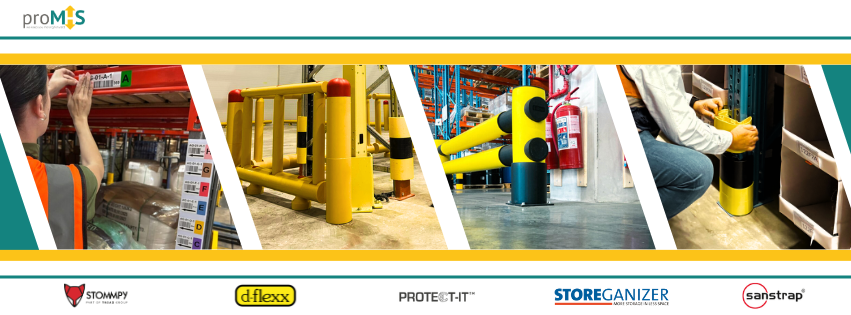
Prevention is equally important. ProMHS supplies and installs industry-leading impact protection solutions, including Protect-it upright protection, as well as STOMMPY and D-Flexx systems, both of which now form part of the Troax Group. Protect-it provides effective protection for vulnerable rack uprights, helping to minimise damage from everyday forklift impacts. STOMMPY solutions are particularly suited to food, beverage, and pharmaceutical facilities where hygiene standards and concrete preservation are critical, while D-Flexx flexible safety barriers are widely used in logistics, warehousing, and distribution environments to protect people, infrastructure, and equipment from vehicle impacts. Together, these solutions help prevent damage before it occurs, extending the lifespan of racking while reducing repair and replacement costs.
The reality is simple: protecting your racking is significantly less expensive than replacing it.
2. Poor Labelling: Small Errors with Big Consequences
Labelling may seem like a simple administrative task, but poor warehouse labelling can create costly operational problems.
When locations are unclear, damaged, inconsistent or incorrectly identified, businesses experience:
• Increased picking errors
• Longer search times
• Delayed dispatches
• Inventory inaccuracies
• Reduced staff productivity
• Customer dissatisfaction
In fast-moving warehouse environments, every extra minute spent searching for stock directly affects profitability.
How to Reduce the Risk
A professionally designed warehouse labelling system creates clarity, consistency and efficiency throughout the operation.
ProMHS specialises in warehouse labelling and signage solutions designed to improve inventory accuracy and operational flow. From rack labels and aisle signage to floor markings, pallet location identifiers, barcode systems and large-scale warehouse identification projects, our team ensures every location is clearly visible and easy to navigate.
A well-labelled warehouse not only improves productivity but also supports compliance, safety and warehouse management system integration.
3. Inefficient Storage: Paying for Space You’re Not Using
Warehouse space is one of the most expensive assets in any operation, yet many facilities fail to maximise its full potential.
Common signs of inefficient storage include:
• Congested aisles
• Excessive travel distances
• Poor stock accessibility
• Underutilised vertical space
• Growing pressure to relocate or expand
The result is increased labour costs, reduced productivity and unnecessary pressure to move into larger facilities before existing space has been fully optimised.
How to Reduce the Risk
Many businesses can significantly improve storage capacity without increasing their warehouse footprint.
ProMHS provides warehouse consulting, storage optimisation and project management services that help businesses improve warehouse layouts, product flow and storage density.
We also supply innovative solutions such as Storeganizer, a high-density storage system designed to maximise cubic storage capacity while improving accessibility and picking efficiency. By converting wasted airspace into usable storage space, businesses can often delay or completely avoid expensive warehouse expansions.
The question is not whether you need more space. The question is whether you are using the space you already have effectively.
4. Fire Risks: The Hidden Cost That Can Shut Down Your Business Overnight
Most warehouse managers focus on productivity, stock accuracy and equipment uptime. Yet one of the biggest financial risks often receives attention only after an incident occurs: fire.
A warehouse fire can destroy stock, damage infrastructure, disrupt operations and impact customer relationships for months after the flames have been extinguished. Even a relatively small fire can result in significant repair costs, insurance claims, production delays and lost revenue.
Common warehouse fire risks include:
• Damaged electrical infrastructure
• Excessive packaging waste and combustible materials
• Poor housekeeping practices
• Improper storage of goods
• Obstructed emergency exits and evacuation routes
• Vehicle impacts damaging critical infrastructure
Why Fire Risks Are Often Overlooked
Many warehouse fires are not caused by a single major event but by a combination of smaller issues that go unnoticed over time. A damaged electrical cabinet, accumulated plastic waste, blocked escape route or poorly maintained storage area can quickly turn a minor incident into a major disruption.
One often-overlooked contributor is the accumulation of packaging materials. Large volumes of discarded stretch wrap, damaged pallets and other combustible waste can increase the fire load within a facility and accelerate the spread of a fire once it starts.
How to Reduce the Risk
Reducing fire risk starts with creating a safer and more organised warehouse environment.
Clear floor demarcation, pedestrian walkways and safety signage help employees identify emergency escape routes quickly during an evacuation. Good housekeeping practices reduce combustible waste and improve overall safety standards.
Protecting critical infrastructure is equally important. Forklift impacts can damage electrical installations, support columns, sprinkler systems and other assets that are essential for safe operations.
ProMHS supplies advanced warehouse protection solutions such as Stommpy safety barriers, bollards and column protectors that help reduce the likelihood of accidental damage to critical infrastructure. Manufactured from Tecklene®, Stommpy’s proprietary polymer, these solutions are engineered to absorb impacts while offering fire-resistant behaviour, without shattering, breaking or releasing toxic substances under extreme conditions. This helps businesses protect critical infrastructure, minimise risk and maintain safer operating environments during both everyday operations and emergency situations.
Businesses can also reduce unnecessary packaging waste by exploring reusable load-securing solutions such as Sanstrap® reusable stretch bands. By reducing reliance on disposable stretch wrap, warehouses can maintain cleaner operations, improve sustainability and reduce combustible waste accumulation.
Did You Know?
Many warehouse fires originate from preventable causes such as poor housekeeping, electrical faults, combustible waste accumulation and operational damage to critical infrastructure. Regular audits, preventative maintenance and effective warehouse safety systems remain some of the most effective ways to reduce risk.
Fire risk management is not simply about having extinguishers on-site. It requires a proactive approach to housekeeping, infrastructure protection, warehouse organisation and employee safety.
When it comes to warehouse fires, the true cost is often not the fire itself — it is the operational downtime, lost productivity and business disruption that follows.
5. Traffic Collisions: The Hidden Cost of Warehouse Movement
Forklifts, pallet jacks, pedestrians, contractors and visitors all operate within the same environment.
Without proper traffic management, warehouses become vulnerable to collisions that result in equipment damage, product loss, injuries and costly downtime.
Many incidents occur because:
• Pedestrian routes are poorly defined
• Impact protection is inadequate
• Blind corners are unmanaged
• Traffic flow is unclear
• High-risk areas are unprotected
Even low-speed collisions can create significant repair costs and operational disruptions.
How to Reduce the Risk
One of the most effective ways to reduce warehouse collisions is through physical segregation and impact protection.
ProMHS supplies and installs D-Flexx flexible barrier systems, safety bollards, pedestrian protection barriers and traffic management solutions designed specifically for warehouse environments.
Unlike traditional steel barriers, D-Flexx systems absorb and dissipate impact energy, reducing damage to vehicles, infrastructure and equipment while helping protect employees and visitors.
Combined with clear floor markings, warehouse signage and professionally planned traffic routes, these solutions create safer working environments and significantly reduce the costs associated with workplace accidents.
The Real Cost of Ignoring Warehouse Risks
Many warehouse risks don’t appear on financial reports as a single line item.
Instead, they show up as:
• Reduced productivity
• Increased maintenance costs
• Stock damage
• Higher insurance claims
• Safety incidents
• Labour inefficiencies
• Customer complaints
• Lost operational time
Over time, these hidden costs can have a significant impact on profitability and business growth.
The most successful warehouses are not necessarily the largest or busiest. They are the safest, most organised and most efficient.
Expert Insight from ProMHS
“Many businesses don’t realise how much money is being lost through avoidable warehouse risks until we conduct an assessment. Whether it’s damaged racking, inefficient storage layouts, poor labelling or inadequate impact protection, there are often opportunities to improve safety and efficiency while reducing operational costs. The key is being proactive rather than waiting for a costly incident to occur.”
— Iain Sherwood, Managing Director, ProMHS
Partner with ProMHS
At ProMHS, we don’t just identify warehouse risks — we help businesses solve them.
Whether it’s conducting rack inspections, implementing warehouse labelling systems, optimising storage layouts, supplying Storeganizer high-density storage solutions, or installing D-Flexx, Stommpy and Protect-it impact protection systems, our team works alongside customers to create safer, more efficient and more profitable warehouse operations.
Every warehouse is different. That’s why we take the time to understand your operation and recommend practical solutions that deliver measurable improvements in safety, efficiency and performance.
Ready to uncover the hidden risks in your warehouse?
Contact ProMHS today for a professional warehouse assessment and discover how small improvements can deliver significant long-term savings.
Get in touch with us today for expert advice on all things warehousing.
We keep you moving forward!
📞 010 447 3520
✉️ enquiries@promhs.co.za
🌐 https://www.promhs.co.za/contact-us/